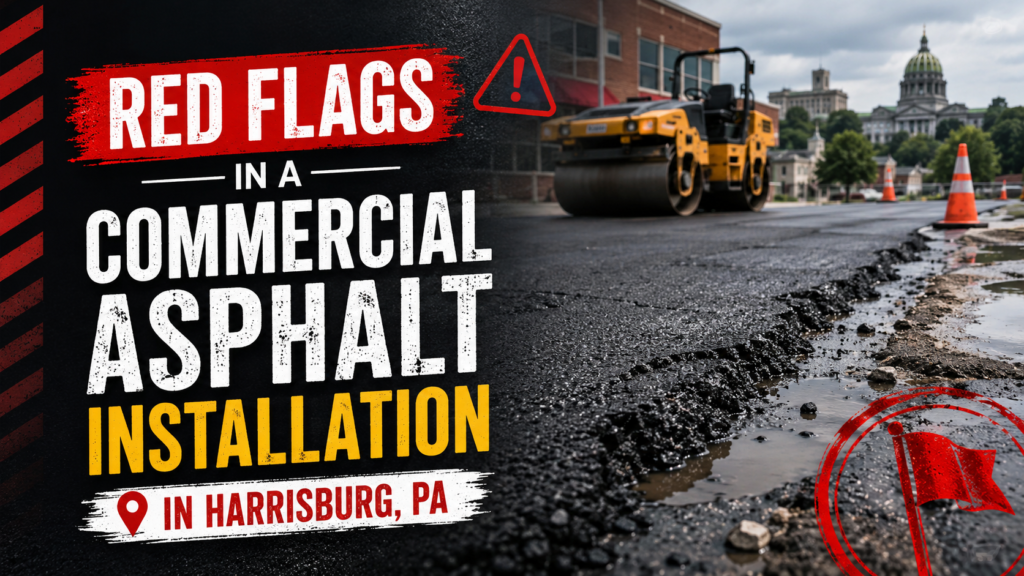
Commercial Asphalt Installation Harrisburg is a significant capital investment for property owners and businesses throughout the Harrisburg area. A parking lot, access road, or commercial driveway represents tens of thousands of dollars and must perform reliably through Pennsylvania climate for two decades or more to deliver its full value. The commercial paving industry, like most construction trades, has a wide range of quality levels, and the lowest-quality providers can produce installations that fail within three to five years while appearing indistinguishable from quality work at the time of completion. Knowing the red flags to watch for during and after a commercial asphalt installation gives Harrisburg property owners and facilities managers the awareness to identify substandard work before the warranty period expires and before winter freeze-thaw cycles expose what corners were cut to hide.
Before the Project Begins: Proposal Red Flags
- No specific base depth is stated: A legitimate commercial paving proposal specifies the compacted depth of aggregate base to be installed. Any proposal that does not include this specification or that provides vague language like “adequate base” should be treated with caution. The aggregate base is the most important and most frequently shortcut element of commercial paving. Without a specific depth commitment, there is no accountability if inadequate base is installed.
- No mention of sub-grade preparation: Proper asphalt installation begins with sub-grade excavation, inspection, and compaction. A proposal that discusses only the asphalt surface without addressing what happens below it is describing an incomplete scope of work.
- Unusually low price without explanation: Commercial paving requires specific quantities of material and labor to meet quality standards. A price significantly below competitive bids without a clear explanation of what is different in scope is typically reflecting reduced material quantities, inadequate base depth, or other shortcuts that will manifest as early failure.
During Installation: On-Site Red Flags
- Inadequate excavation depth: A contractor who removes only an inch or two of existing material and then places new base and asphalt has not removed the organic topsoil and compromised material that will continue to settle under the new pavement. The excavation should be 8 to 10 inches total below finished pavement grade for standard commercial applications.
- Base placed in a single thick lift: Proper compaction requires placing aggregate base in lifts of 3 to 4 inches and compacting each lift before placing the next. A contractor who places 6 or more inches of base in a single operation and compacts it once is producing inadequate compaction density particularly at the lower levels, where it matters most for long-term structural performance.
- Asphalt delivered and placed too cold: Hot mix asphalt cools rapidly from the time it leaves the plant. Material that arrives at the job site already below working temperature cannot be properly compacted. An experienced observer can identify asphalt that is too cool it will not compact smoothly under the roller and will show surface texture inconsistencies.
- Insufficient roller passes: Achieving design density in hot mix asphalt requires multiple roller passes during the temperature window when the material is workable. A contractor who makes two or three passes of a lightweight roller and moves on has not achieved adequate compaction. Quality installation involves multiple passes of the breakdown roller, intermediate roller, and finish roller, with the sequence managed to achieve density before the material cools.
After Installation: Post-Completion Red Flags
- Visible edge crumbling within weeks of installation: Well-installed asphalt edges are compacted smooth and stable. Edges that begin crumbling or raveling within weeks of installation indicate inadequate edge compaction the most visually prominent sign of sloppy finish work.
- Surface raveling (stone coming loose from the surface): If aggregate particles can be kicked loose from the surface weeks after installation, the asphalt was placed too cold, under-compacted, or both. A quality surface has aggregate locked firmly in place by the compacted binder matrix.
- Drainage problems immediately post-installation: Standing water in low areas of a newly paved commercial lot indicates that drainage was not properly designed into the grading of the base and surface layers. This is not just aesthetic it is a structural problem that will advance deterioration rapidly in Harrisburg freeze-thaw climate.
What to Do When Red Flags Appear
When red flags are identified during or immediately after a commercial asphalt installation, property owners should raise concerns with the contractor in writing before making final payment. Documenting specific concerns with photographs provides contemporaneous evidence of the conditions. If the contractor refuses to acknowledge or address legitimate quality concerns, the property owner may have grounds for a claim under the project contract and any applicable warranty.
Conclusion
Red flags in a commercial asphalt installation in Harrisburg often appear as subtle departures from proper practice that are not obvious to untrained observers inadequate excavation depth, base placed in single thick lifts, asphalt placed too cold, or insufficient roller passes. Understanding these warning signs, observing the installation process attentively, and reviewing completed work for early failure indicators before winter enables Harrisburg commercial property owners to identify substandard work while remediation is still straightforward and practical. The alternative discovering failures after several Pennsylvania winters have exposed them is significantly more expensive and disruptive.